-Sigma Factor-
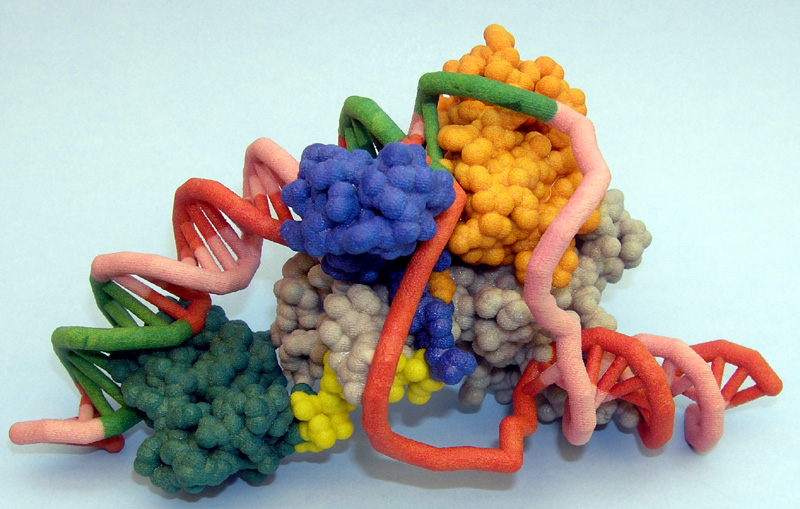
(http://www.pingrysmartteam.com/)
- An Overview of Transcription
Definition: the formation of an RNA molecule upon a DNA template by complementary base pairing; mediated by RNA polymerase
The process of transcription can be divided into three stages:
1) Initiation of a new RNA chain (parts 1-4 of the picture below).
2) Elongation of the chain (parts 5&6 of the picture below).
3) Termination of transcription and release of the brand new RNA molecule (parts 6&7 of the picture below).

The Sigma Factor is involved in the initiation process of prokaryotic transcritption.
The initiation process can be broken down:
1) Binding of the RNA polymerase holoenzyme to a promoter region in DNA,
2) The localized unwinding of the two strands of DNA by RNA polymerase, providing a template strand free to base-pair with incoming ribonucleotides, and
3) The formation of phosphodiester bonds between the first few ribonucleotides in the nascent RNA chain.
The holoenzyme remains bound at the promoter region during the synthesis of the first eight or nine bonds, then the sigma factor is released, and the core enzyme begins the elongation phase of RNA synthesis. During initiation, short chains of two to nine ribonucleotides are synthesized and released. This abortive synthesis stops once chains of ten or more ribonucleotides have been synthesized and RNA polymerase has begun to move downstream from the promoter.
Two good videos of Transcription (that sadly do not explain the role of the Sigma Factor)
http://henge.bio.miami.edu/mallery/movies/transcription.mov
http://www.dnai.org/lesson/go/19436/15510
- Description of the Sigma Factor
The Sigma Factor is involved in the Initiation step of Trancscription in Prokaryotic life.
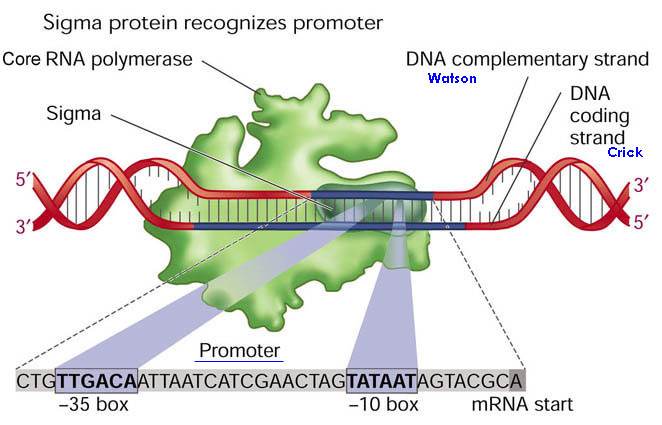
It is a polypeptide subunit of the RNA polymerase. It serves to recognize specific binding sites on DNA molecules for initiation of RNA transcription.

(http://www.bio.miami.edu/~cmallery/)
The sigma factor is the subunit of the RNA Polymerase complex that recognizes the specific promoter sequence of DNA that the RNA Polymerase complex should bind to. This will be the initial site for DNA transcription, or where it initiates.
Different Sigma Factors are activated in response to different environmental conditions, so that not all genes are being expressed at the same time. By simply modifying the Sigma Factor used, prokaryotes only have to use one type of RNA Polymerase to regulate gene expression.
| Sigma Factor |
Promoters Recognized |
PromoterConsensus
|
| |
|
-35 region |
-10 region |
| σ70 |
most genes |
TTGACAT |
TATAAT |
| σ32 |
genes induced by heat shock |
TCTCNCCCTTGAA |
CCCCATNTA |
| σ38 |
genes for stationary phase and stress response |
? |
? |
| σ28 |
genes involved in motility and chemotaxis |
CTAAA |
CCGATAT
|
| |
|
-24 region |
-12 region |
| σ54 |
genes for nitrogen metabolism |
CTGGNA |
TTGCA |
* 1, 2
The Sigma factor recognizes the promoter sequence on the DNA, a special sequence of nucleotides indicating the starting point for RNA synthesis, by having a sequence on it that matches to the promoter sequence. The likelihood of the bases in the promoter are shown below:

Without the sigma factor, RNA polymerase would bind loosely and randomly to DNA, but would not be able to start transcription. Therefore no proteins would be made and the cell would die.
In the regulation of gene expression in prokaryotes, anti-sigma factors bind to sigma factors and inhibit their transcriptional activity. (wikipedia.org) They regulate promoter utilization by targetting specific sigma factors. (Yuan et al, 2009).
- Current Work Involving Sigma Factors
-The Sigma Factor has been shown to be a useful pathway for the inhibition of transcription using phages that restrict it's use (Dehbi et al, 2009).
-There has been much work on locating sigma-dependent genes in different bacterial species. (Ding et al, 2009), (Mehra et al, 2009). Some studies have examined how the regulation of the different sigma subunits affects gene expression. (Polari et al, 2009), (Burrows et al, 2009)
-A study of the long-term effects of the induction of sigma(H) on the global transcription in Mycobacterium tuberculosis. (Mehra et al, 2009)
-A study also suggests that the extracytoplasmic sigma factor, rpoE4, has a relevant function in the cell envelope biogenesis, and that it plays a role as a general regulator in the response to several kinds of stress. (Matinez-Salazer et al, 2009)
emporia.edu
wikipedia.org/Sigma_factor
ncbi.nlm.nih.gov/books/
http://henge.bio.miami.edu/mallery/movies/transcription.mov
http://www.dnai.org/lesson/go/19436/15510
1http://www.ncbi.nlm.nih.gov/books/bv.fcgi?rid=mboc4.table.1319
2http://www.ncbi.nlm.nih.gov/books/bv.fcgi?rid=mcb.table.2520
http://en.wikipedia.org/wiki/Anti-sigma_factors
http://www.ncbi.nlm.nih.gov/pubmed/19376864
http://www.ncbi.nlm.nih.gov/pubmed/19383707
http://www.ncbi.nlm.nih.gov/pubmed/19376862
http://www.ncbi.nlm.nih.gov/pubmed/19376862
http://www.ncbi.nlm.nih.gov/pubmed/19366670
http://www.ncbi.nlm.nih.gov/pubmed/19363110
http://www.ncbi.nlm.nih.gov/pubmed/19356588
http://www.ncbi.nlm.nih.gov/pubmed/19376852

Comments (1)
Christopher Korey said
at 3:23 pm on Apr 6, 2009
Outline looks good. Add in some more detail, but then also provide link outs to the information you will be referencing. It will be important to reference your sources and use the foot noting. Each section should be a clear and concise description and then provide links to more detailed information. Things to think about--any drugs targeting sigma. Anything interesting new information about sigma out there?
You don't have permission to comment on this page.